
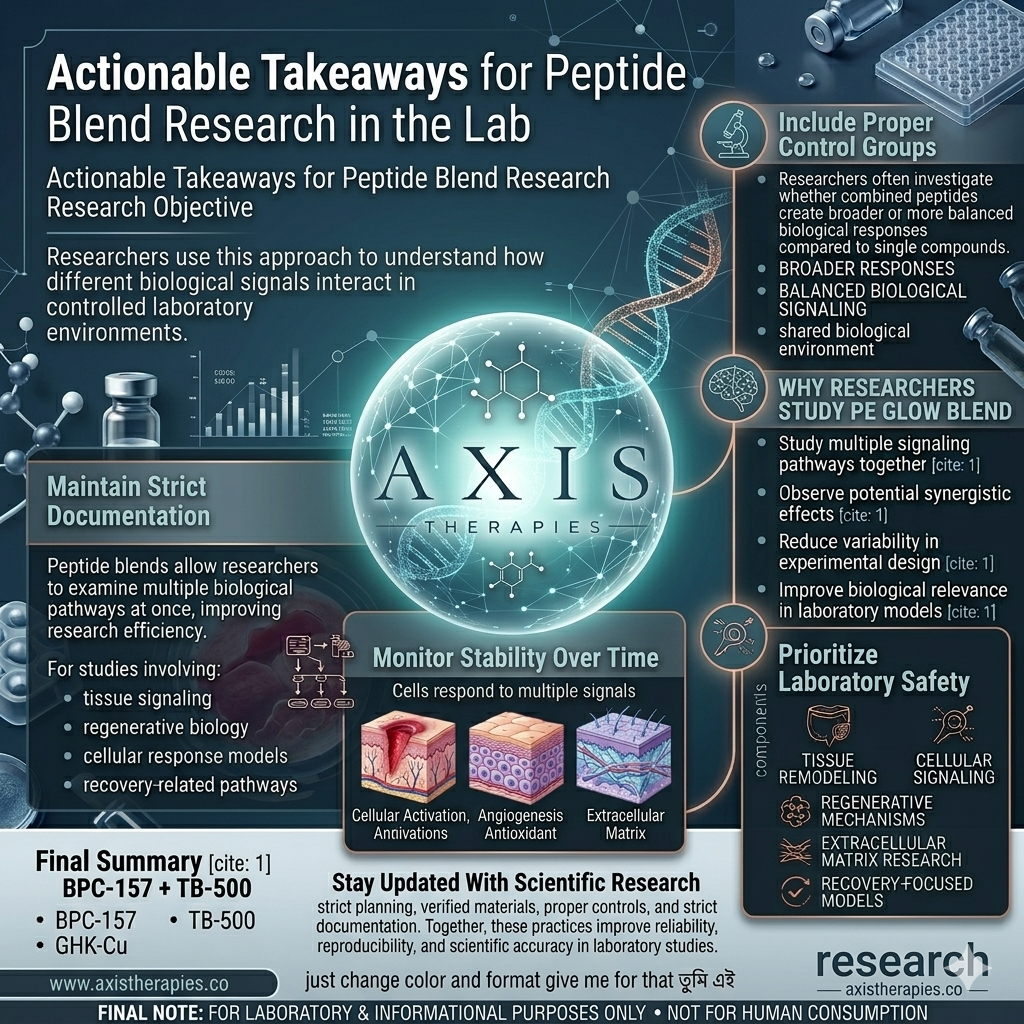
Actionable Takeaways for Peptide Blend Research in the Lab

Actionable Takeaways for Peptide Blend Research
Peptide blend research becomes more reliable when laboratories follow structured and consistent experimental practices. Since multi-peptide formulations involve complex biological interactions, careful planning and documentation are essential for producing accurate and reproducible results.
Define a Clear Research Objective
Before starting any experiment, researchers should clearly define the scientific question. This step helps guide the selection of appropriate peptide blends and ensures that the study remains focused on specific biological pathways.
In addition, a clear objective reduces unnecessary variability in experimental design and improves overall study efficiency.
Use Verified High-Purity Materials
Researchers should always source peptides from verified suppliers that provide COA (Certificate of Analysis) and third-party testing data. This ensures product consistency and reduces variability in experimental outcomes.
Moreover, verified materials help maintain trust in research results and improve reproducibility across different laboratory settings.
Include Proper Control Groups
Control groups are essential in peptide blend research. Researchers should include:
- single-peptide groups
- vehicle or baseline controls
These comparisons help identify whether observed effects are due to peptide combinations or individual compounds. As a result, data interpretation becomes more accurate and reliable.
Maintain Strict Documentation
Accurate documentation is a key part of laboratory research. Researchers should record:
- reconstitution methods
- storage conditions
- concentration details
- experimental timelines
Furthermore, consistent documentation improves reproducibility and supports future validation studies.
Monitor Stability Over Time
Peptides may change over time depending on storage and handling conditions. Therefore, researchers should periodically test fresh and stored samples to evaluate stability.
This process helps ensure that experimental results remain consistent and scientifically valid.
Stay Updated With Scientific Research
Peptide research continues to evolve rapidly. For this reason, researchers should regularly review scientific journals, publications, and conferences focused on regenerative and cellular biology.
Staying updated helps laboratories adopt new methods and improve experimental design over time.
Prioritize Laboratory Safety
Safety is a fundamental requirement in all peptide blend research. Researchers should always follow established laboratory protocols and ethical guidelines.
In addition, proper handling procedures reduce contamination risks and improve data quality.
Final Summary
Peptide blend research produces the best results when it follows structured planning, verified materials, proper controls, and strict documentation. Together, these practices improve reliability, reproducibility, and scientific accuracy in laboratory studies.
Visit Our website axistherapies.co