
Current Trends in Peptide Blend Research (2026 Insights)
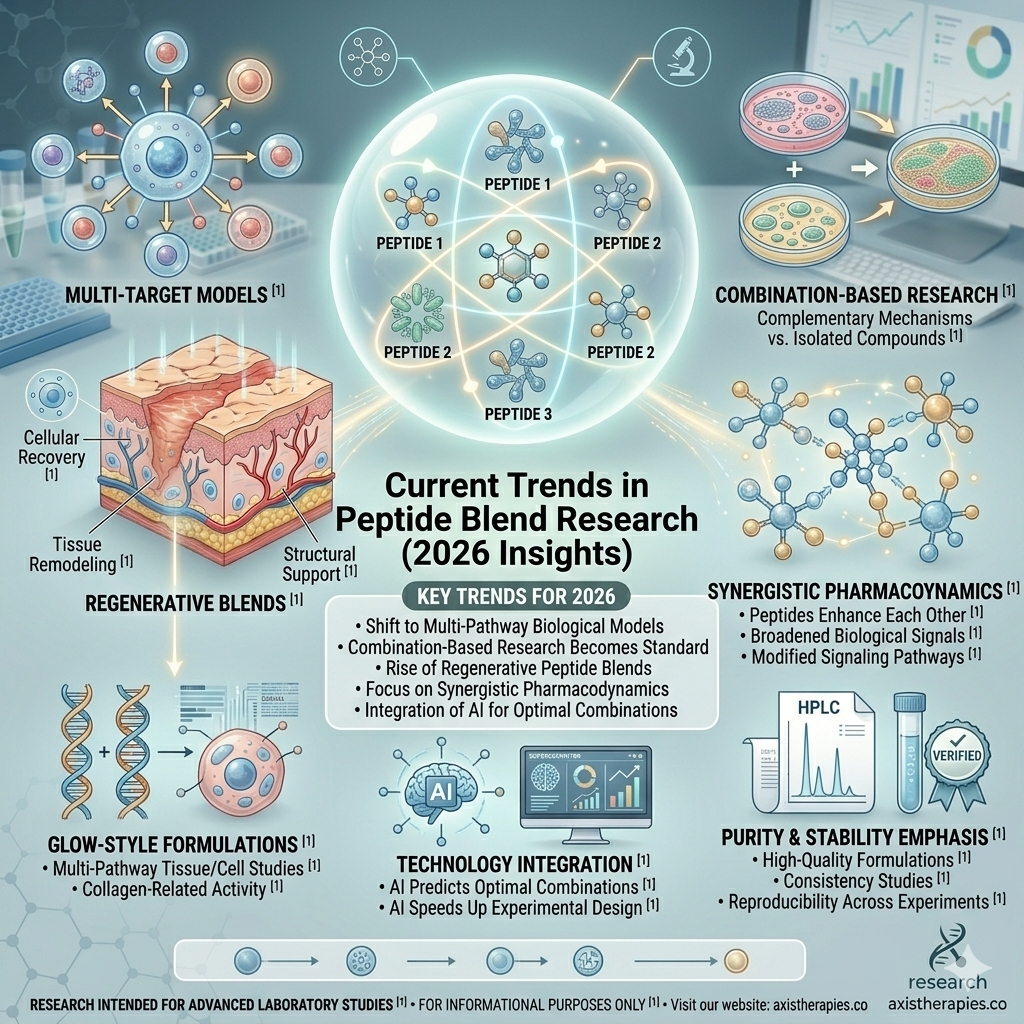
Peptide blend research is evolving rapidly as laboratories move toward more advanced multi-pathway biological models. By 2026, researchers increasingly focus on multi-peptide formulations because they allow more realistic simulation of complex biological systems.
Instead of studying single compounds, scientists now examine how multiple peptides interact within regenerative, metabolic, and cellular environments.
Combination-Based Research Becomes Standard
One major trend is the shift toward combination-based research models. Researchers now prefer peptide blends that contain complementary mechanisms rather than isolated compounds.
As a result, multi-peptide formulations are becoming more common in laboratory studies. These blends often produce broader biological insights compared to single-peptide approaches.
In addition, combination models help researchers reduce experimental limitations and improve data depth.
Growth of Regenerative Peptide Blends
Another key trend is the rise of regenerative peptide blends. Scientists increasingly study combinations that focus on tissue repair, structural support, and extracellular matrix activity.
These formulations are widely used in models involving:
- tissue remodeling
- cellular recovery
- structural biology
- regenerative signaling
Furthermore, researchers continue to explore how different peptides interact within these systems.
Focus on Synergistic Pharmacodynamics
Modern peptide research now emphasizes synergistic pharmacodynamics. This means researchers analyze how peptides influence each other when combined.
Instead of measuring single effects, scientists study how blended compounds may enhance or modify biological signaling pathways.
This approach helps improve understanding of complex biological interactions.
Rise of Glow-Style Formulations
Glow-style peptide formulations are also gaining attention in research environments. These blends often focus on multi-pathway tissue and cellular studies.
In addition, researchers use these models to explore collagen-related activity, structural signaling, and regenerative processes.
As a result, Glow-type formulations are becoming more common in laboratory research discussions.
Integration of AI in Peptide Research
Artificial intelligence is becoming an important tool in peptide blend research. Researchers now use AI models to predict optimal peptide combinations and study potential interactions.
Moreover, AI helps analyze complex biological datasets more efficiently. This improves research accuracy and speeds up experimental design.
Emphasis on Purity and Stability
Another important trend is the increased focus on purity and stability in peptide blends. Researchers now prioritize high-quality formulations with verified consistency.
In addition, stability studies help ensure that peptide combinations remain reliable during laboratory use. This improves reproducibility across experiments.
Shift Toward Multi-Target Research Models
Overall, peptide research is shifting from single-target to multi-target approaches. This change reflects a broader trend in pharmaceutical and biological sciences.
Because biological systems are highly interconnected, multi-peptide models provide a more realistic framework for modern research.
Therefore, peptide blend research continues to play a central role in advanced laboratory studies moving into 2026 and beyond.
Visit Our website axistherapies.co