
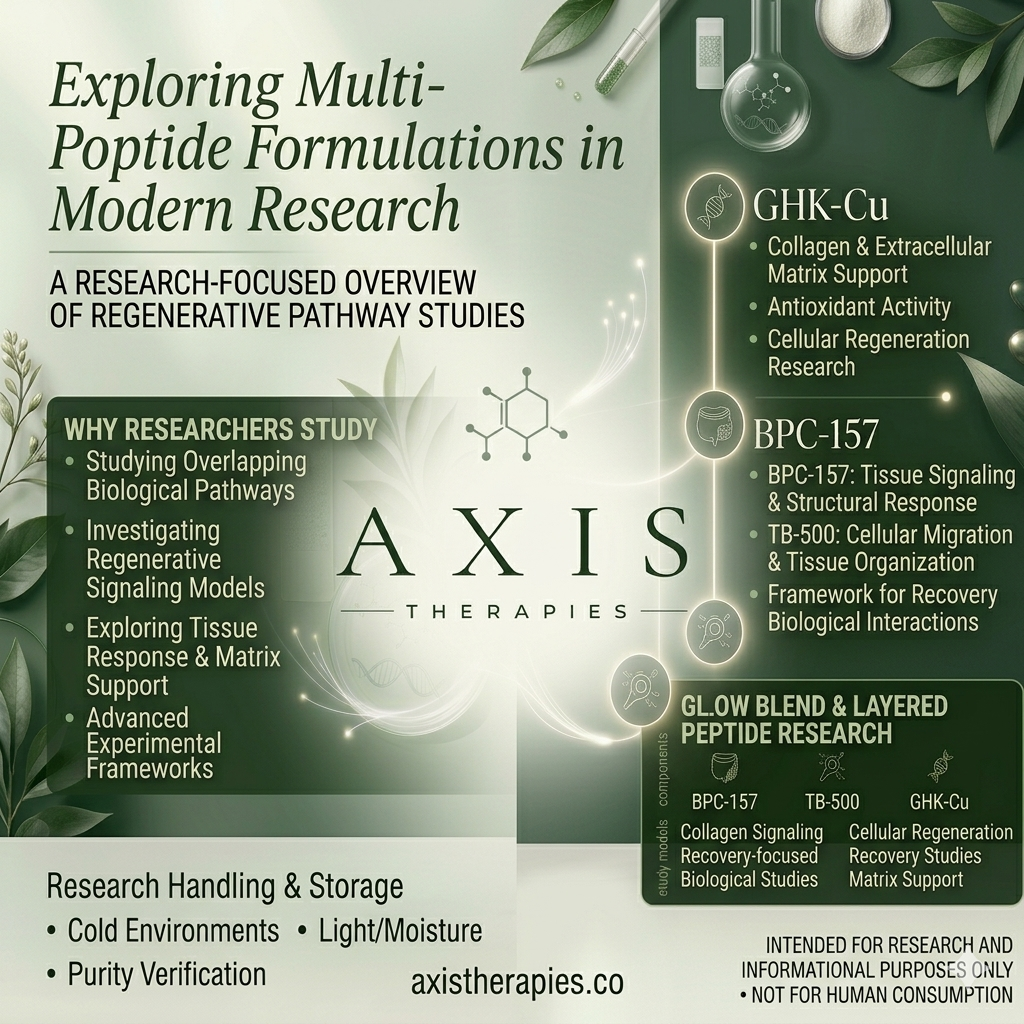

What Is Peptide Blend Research?
Peptide blend research continues to expand as laboratories investigate multi-peptide formulations for regenerative biology, tissue signaling, and recovery-focused studies.
Researchers increasingly study peptide blends because biological systems rely on multiple signaling pathways working together. Instead of examining a single compound in isolation, scientists use structured peptide formulations to investigate layered biological interactions within controlled laboratory environments.
Popular peptide blends often combine compounds associated with tissue remodeling, collagen support, cellular signaling, and recovery-related research pathways.
Why Researchers Study Peptide Blends
Modern regenerative research frequently focuses on how multiple pathways interact simultaneously. Because of this, peptide blends have become increasingly important in laboratory studies.
Researchers commonly investigate peptide blends to:
- study synergistic biological interactions
- explore tissue response pathways
- examine angiogenesis and cellular signaling
- investigate collagen-related activity
- create broader regenerative research models
Interest in peptide blend research continues growing across longevity-focused and recovery-focused laboratory environments.
BPC-157 + TB-500 Peptide Blend Research
One of the most recognized peptide combinations in laboratory research is BPC-157 + TB-500.
Researchers commonly study BPC-157 in relation to tissue signaling, connective tissue research, and recovery-focused biological pathways. Laboratory models frequently investigate its interaction with angiogenesis and inflammation-related signaling systems.
Scientists also study TB-500 for its potential involvement in cell migration and tissue remodeling processes. Research often focuses on structural organization and regenerative pathway activity.
When studied together, these peptides allow researchers to investigate broader regenerative signaling interactions within structured experimental models.
Glow Blend Peptide Research
Glow Blend formulations combine:
- BPC-157
- TB-500
- GHK-Cu
Researchers commonly study GHK-Cu, also known as Copper Tripeptide-1, for its relationship with collagen production, extracellular matrix activity, and antioxidant-related pathways.
Scientists often investigate Glow Blend peptide research in laboratory studies involving:
- tissue remodeling
- matrix support
- cellular recovery
- collagen signaling
- regenerative biology
This type of multi-peptide formulation allows researchers to explore several biological mechanisms within one structured research protocol.
Common Applications in Peptide Blend Research
Researchers continue exploring peptide blends across several laboratory categories.
Tissue Remodeling Research
Scientists investigate peptide blends in models involving connective tissue signaling and structural response pathways.
Cellular Recovery Studies
Researchers study how multi-peptide formulations interact with stress-response and recovery-related biological activity.
Matrix and Collagen Research
Compounds such as GHK-Cu are commonly examined in extracellular matrix and collagen-focused laboratory studies.
Regenerative Biology
Peptide blends are increasingly studied in regenerative and longevity-focused research environments.
Storage and Handling Standards
Proper handling remains essential for maintaining research consistency and peptide stability.
Researchers commonly:
- store peptide formulations in controlled cold environments
- reduce exposure to light and moisture
- verify purity standards using third-party testing
- maintain accurate storage documentation
Consistent handling protocols help improve reliability across laboratory research applications.
Future of Peptide Blend Research
Interest in peptide blend research continues increasing as laboratories move toward more advanced multi-pathway biological models.
Researchers are increasingly studying:
- regenerative peptide formulations
- recovery-focused blends
- collagen signaling compounds
- longevity-related pathways
- advanced tissue response systems
Modern peptide research continues evolving toward more structured and synergistic laboratory investigations.
Final Notes
Peptide blend research provides researchers with a more advanced framework for studying complex biological interactions. Formulations such as Glow Blend and BPC-157 + TB-500 continue gaining attention across regenerative and recovery-focused research discussions.
Visit Our website axistherapies.co