
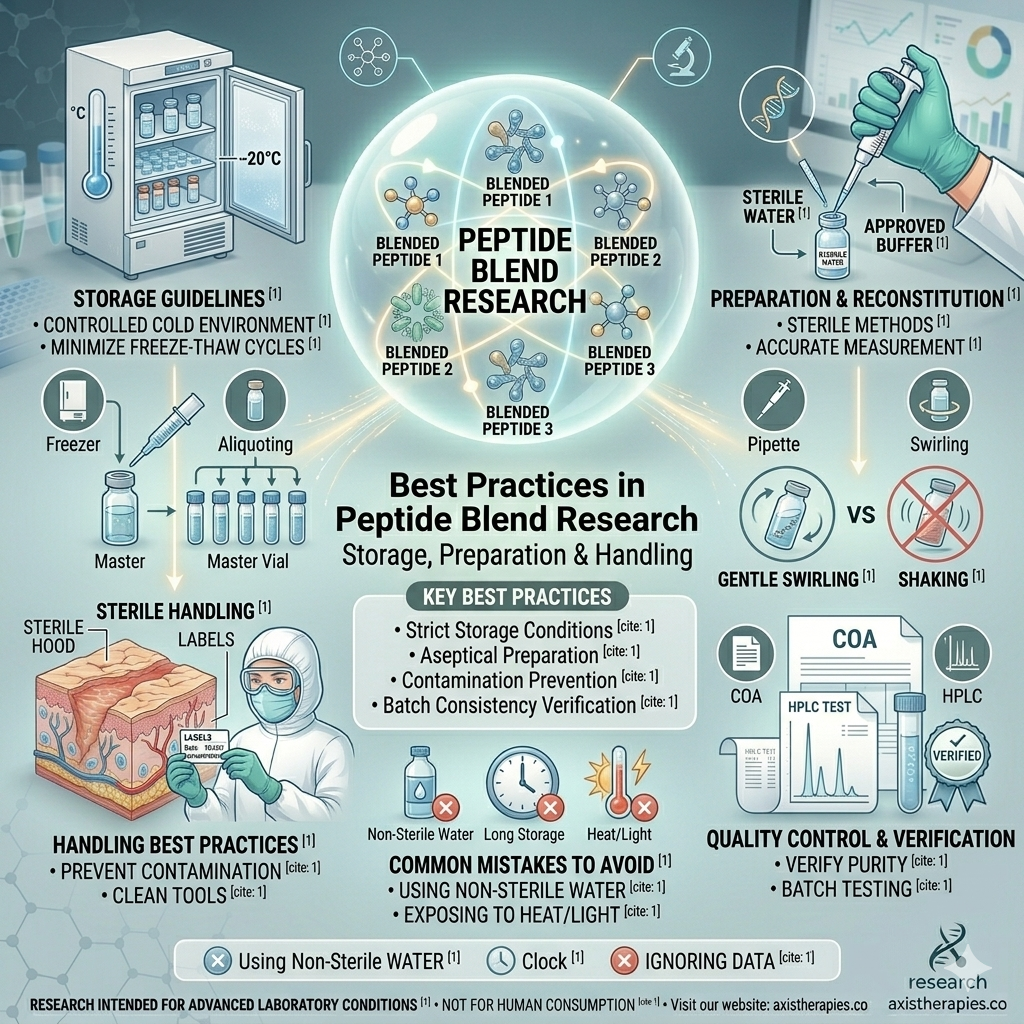
Best Practices for Peptide Blend Research: Storage, Preparation & Handling

Best Practices in Peptide Blend Research
Peptide blend research requires strict attention to storage, preparation, and handling procedures. Proper laboratory practice ensures consistency, stability, and reproducibility across experiments.
Since peptides are sensitive biological compounds, even small errors in handling can affect research outcomes. Therefore, standardized protocols are essential in all peptide-based studies.
Storage Guidelines for Peptide Blends
Correct storage plays a critical role in maintaining peptide stability. Researchers typically store lyophilized peptide vials under controlled conditions to preserve structural integrity.
Best storage practices include:
- keeping vials at approximately -20°C in a dry environment
- protecting samples from light exposure
- avoiding moisture contamination
- minimizing freeze-thaw cycles by using aliquots
In addition, stable storage conditions help maintain consistent research quality over time.
Preparation and Reconstitution
Proper preparation is essential before using peptide blends in laboratory studies. Researchers typically reconstitute lyophilized peptides using sterile and appropriate solutions.
Common preparation practices include:
- using sterile bacteriostatic water or approved buffers
- gently swirling the vial instead of shaking
- ensuring accurate measurement with calibrated pipettes
Moreover, careful preparation helps maintain peptide structure and improves experimental reliability.
Handling Best Practices
Peptide blend research requires sterile handling techniques to prevent contamination and ensure data accuracy.
Researchers generally follow these practices:
- working in sterile laboratory environments
- wearing gloves and protective equipment
- maintaining clean tools and surfaces
- labeling samples clearly with date and concentration
Furthermore, accurate documentation improves traceability and reproducibility in research studies.
Quality Control and Verification
Quality control is an important part of peptide blend research. Researchers often verify purity using analytical methods such as COA (Certificate of Analysis) and HPLC testing.
In addition, batch-specific testing helps ensure consistency across different experimental sets. This reduces variability and improves confidence in research results.
Common Mistakes in Peptide Handling
Several common errors can affect peptide stability and research accuracy. These include:
- using non-sterile water during preparation
- storing reconstituted peptides for too long
- ignoring stability and batch data
- exposing samples to heat or light
Avoiding these mistakes helps maintain reliable experimental outcomes.
Importance of Standardized Protocols
Standardized handling protocols are essential in peptide blend research. Since peptides are sensitive to environmental conditions, consistent procedures help ensure accurate and reproducible results.
As a result, laboratories that follow strict guidelines produce more reliable data in regenerative and cellular research studies.
Final Note
Peptide blend research should always be conducted under proper laboratory conditions. All compounds are intended strictly for research and informational purposes only and are not suitable for human consumption or therapeutic use.
Visit Our website axistherapies.co